
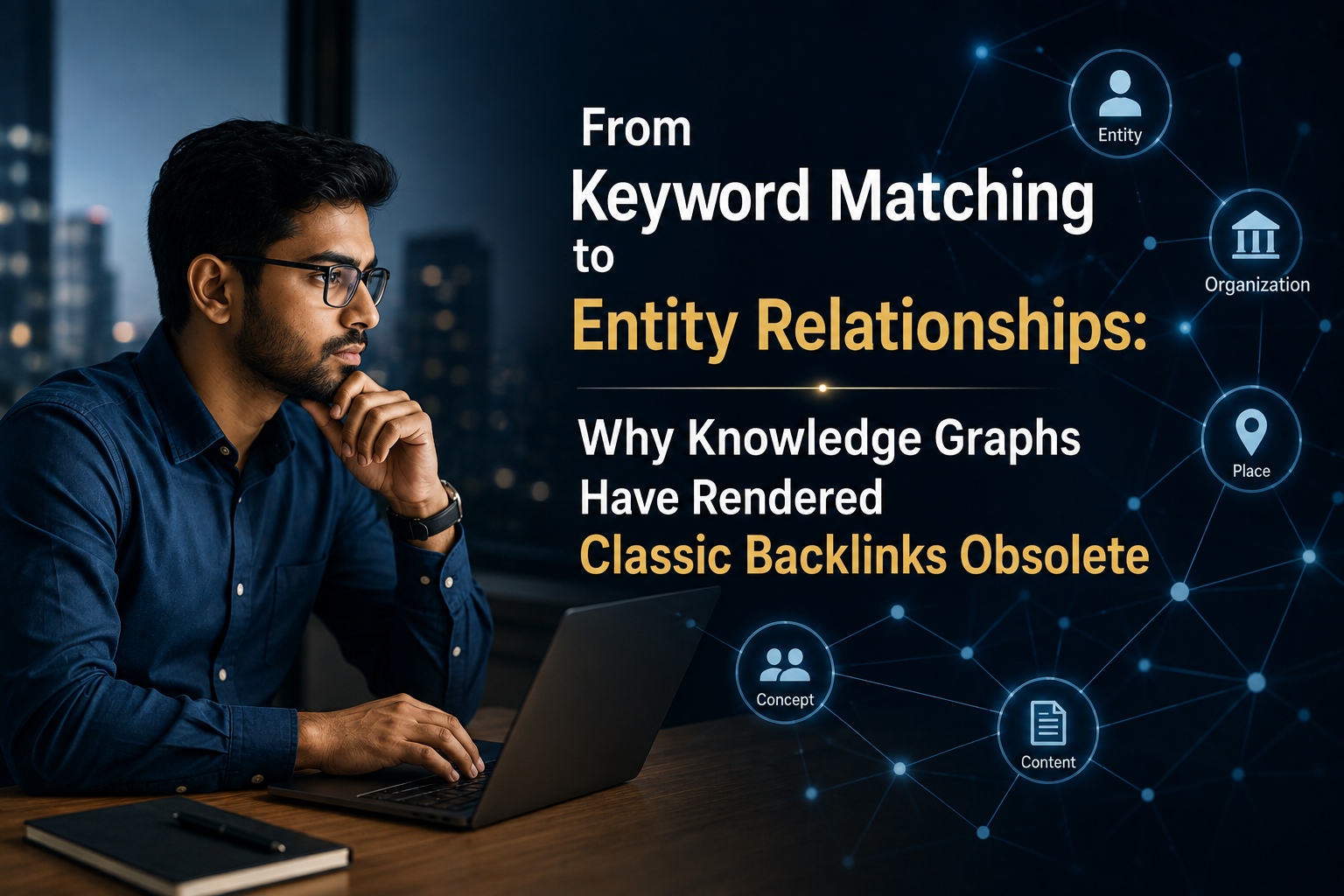
Stop chasing low-tier backlinks; start building verified entity nodes across global databases.
For over two decades, digital marketing relied on a very simple formula. Marketers targeted specific search queries and accumulated as many backlinks as possible. Early search engines operated as sophisticated voting machines. They counted every inbound hyperlink pointing to a webpage as a digital vote of confidence. This primitive era created an entire global industry dedicated exclusively to link building, keyword density analysis, and rank tracking. Today, that traditional model is rapidly collapsing.
Modern search systems no longer read the internet as isolated strings of text. They do not merely count keyword repetitions or tabulate raw backlink profiles. Instead, generative AI and modern search engines understand the world through defined entities. They map complex semantic relationships between people, organisations, places, and core concepts. This fundamental shift means that structured knowledge graphs now dictate digital visibility. If your enterprise only focuses on legacy link building, you remain entirely invisible to the AI models shaping the future of information retrieval.
The Collapse of the Legacy Link Economy
Early search algorithms relied heavily on backlinks because they lacked true semantic understanding. These early algorithms could not actually read or comprehend the context of a webpage. They simply observed that page A linked to page B using specific anchor text. Consequently, acquiring thousands of low-tier links became a highly reliable way to manipulate search engine rankings.
The introduction of Large Language Models (LLMs) and advanced natural language processing changed everything. Modern AI evaluates the underlying meaning and factual accuracy of content rather than simply counting inbound links. When users ask complex, multi-layered questions, systems like Google AI Overviews extract facts directly from structured databases. Suppose a generative search engine encounters a webpage boasting ten thousand low-quality backlinks but zero verified entity signals. It bypasses that page completely.
AI models constantly seek mathematical certainty to prevent hallucinating false information. They intrinsically trust structured, verified entity data over raw, easily manipulated link volume. This stark reality makes traditional keyword matching and artificial link farming entirely ineffective for modern enterprise digital visibility.
Understanding the Mechanics of a Knowledge Graph
A knowledge graph represents a massive, structured database of real-world entities. It organises digital information precisely how the human brain naturally processes it. Instead of storing messy HTML web pages, a knowledge graph stores verified facts and explicit connections. Google’s Knowledge Graph reportedly contains over 1.6 trillion facts regarding 54 billion distinct entities.
Every single knowledge graph relies entirely on three core data primitives:
-
Nodes: These elements represent specific, tangible entities. Examples include a multinational company, a chief executive, or a software product.
-
Edges: These vital connectors define the exact relationships linking the nodes together. For example, an edge might explicitly state that a specific person founded a specific company.
-
Attributes: These data points assign specific properties to individual nodes. Common attributes include a company’s founding year, annual revenue, or physical address.
When you structure your enterprise digital presence as a series of connected nodes, you speak the native language of AI. Search engines immediately stop guessing your contextual relevance. They explicitly understand your exact corporate identity, your precise industry expertise, and your specific service offerings.
The Fallacy of Traditional Keyword Matching
To grasp why entity optimisation dominates modern search, you must understand the deep flaw of keyword matching. A traditional search engine reads the word “apple” as a simple string of five characters. It must analyse surrounding text and inbound links to guess whether the user wants fruit or computers. This guessing process requires significant computational power and frequently produces inaccurate search results.
Entity-based search eliminates this ambiguity completely. An entity engine understands “Apple Inc.” as a distinct multinational technology organisation. The system knows this specific node connects to other precise nodes like “Steve Jobs,” “iPhone,” and “Cupertino.” Search engines recognise real things instead of matching isolated keywords.
This explicit disambiguation process prevents AI engines from conflating your brand with competitors possessing similar names. It removes the uncertainty that previously confused intelligent systems during important data evaluations. When you stop optimising for arbitrary text strings and start optimising for distinct concepts, your digital authority compounds rapidly.
How AI Search Engines Evaluate and Cite Entities
Generative AI platforms utilise Retrieval-Augmented Generation (RAG) pipelines to formulate answers for user queries. When a potential customer submits a prompt, the system does not scan the web for exact-match keywords. It actively queries its internal knowledge graph for highly relevant, verified entity nodes.
If a user searches for a specific enterprise technology solution, the AI first identifies the core abstract concept. It then retrieves verified commercial companies directly associated with that exact concept. The system actively looks for corroborated entity signals across the broader web. Does your brand maintain a verified presence in Wikidata? Does your corporate website feature clean, nested JSON-LD schema markup? Do authoritative industry directories mention your exact business name and operational address?
When AI models find highly consistent entity data across multiple sources, their mathematical confidence score increases rapidly. High confidence scores lead directly to prominent citations in AI-generated answers. A well-built content graph heavily reduces your dependence on massive link volume for topical authority. Recent industry data shows that entity optimisation proves three times more effective than keyword-based SEO for AI-driven search visibility.
A Step-by-Step Blueprint for Building Verified Entity Nodes
Transitioning from a legacy SEO mindset to a modern entity-first approach requires deep technical precision. Enterprises must immediately stop buying random links and start engineering explicit, machine-readable knowledge graphs.
Deploy Advanced Schema Architecture
You must define your entire business ecosystem using deep JSON-LD schema markup. Do not rely on basic, isolated script tags scattered across your homepage. Create a unified, nested data structure. This structure must explicitly connect your organisation, your commercial services, your leadership team, and your physical office locations. This advanced markup acts as a direct, frictionless data feed for hungry AI crawlers.
Anchor Your Brand to Global Databases
Search engines constantly verify your digital identity by cross-referencing massive global databases. You must systematically establish a strong presence on authoritative platforms like Wikidata, Crunchbase, and Wikipedia. Use the explicit sameAs schema property within your code to link your website directly to these external profiles. This deliberate action proves definitively that your digital entity matches a recognised, real-world organisation.
Establish Semantic Internal Linking
Your internal linking strategy must evolve beyond passing simple domain authority. You must use internal links to connect related entity pages logically. Link your core service pages directly to the specific technical articles explaining those services. Link your executive biographies to the specific research papers those executives authored. This internal structure teaches AI models exactly how your internal knowledge graph operates.
Maintain Absolute Entity Consistency
Generative AI models absolutely hate data ambiguity. You must maintain perfect factual consistency across your entire digital footprint. Ensure your exact company name, executive biographies, and core service definitions remain perfectly identical across every platform. Inconsistent information immediately forces AI engines to lower their confidence score. A low confidence score instantly kills your chances of earning valuable AI citations.
The Enterprise Shift to Generative Engine Optimisation
Relying on traditional 2020s SEO tactics leaves modern enterprises highly vulnerable to algorithmic irrelevance. AI overviews now capture a massive, growing share of global search traffic. Consequently, corporate survival depends heavily on Generative Engine Optimisation (GEO). GEO focuses entirely on structuring digital content and site architecture specifically for AI processing systems.
Executing a flawless, enterprise-grade entity strategy requires deep technical expertise. You need specialised professionals who thoroughly understand semantic architecture, machine learning retrieval protocols, and complex data structuring. Moving away from superficial link metrics toward true entity verification demands a complete strategic overhaul.
As a forward-thinking GEO service company in Kochi, TGI Technologies helps enterprise clients transition smoothly away from outdated link-building models. We engineer highly verifiable knowledge graphs that command immediate AI attention. By mapping your corporate assets into machine-readable formats, we ensure search engines instantly recognise your supreme industry authority.
Establishing these interconnected, robust entity networks guarantees long-term digital dominance. Your enterprise may require a complete technical infrastructure overhaul. Alternatively, you might need precise guidance from an expert SEO company in Kerala. Regardless of your exact situation, prioritising entity nodes over keywords remains completely non-negotiable.
The digital ecosystem has permanently evolved past basic text matching. Brands that actively structure their data for sophisticated machine understanding will absolutely dominate the generative search era. Conversely, those marketing teams who continue blindly chasing low-tier backlinks will simply fade into permanent digital obscurity.